GLDP000146
In-House Research
Scalable Accelerated Materials Discovery of Sustainable Polysaccharide-Based Hydrogels by Autonomous Experimentation and Collaborative Learning
Chronicle Description
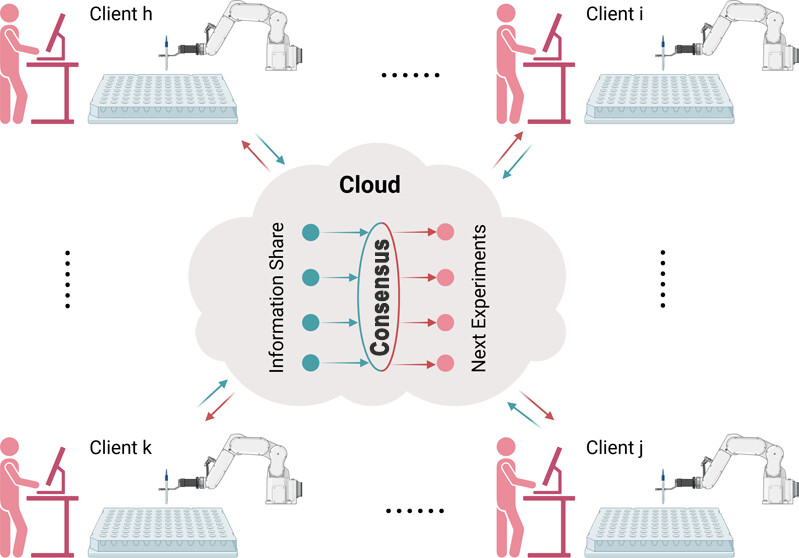
While some materials can be discovered and engineered using standalone self‑driving workflows, coordinating multiple stakeholders and workflows toward a common goal could advance autonomous experimentation (AE) for accelerated materials discovery (AMD). Here, we describe a scalable AMD paradigm based on AE and “collaborative learning”. Collaborative learning using a novel consensus Bayesian optimization (BO) model enabled the rapid discovery of mechanically optimized composite polysaccharide hydrogels. The collaborative workflow outperformed a non‑collaborating AMD workflow scaled by independent learning based on the trend of mechanical property evolution over eight experimental iterations, corresponding to a budget limit. After five iterations, four collaborating clients obtained notable material performance (i.e., composition discovery). Collaborative learning by consensus BO can enable scaling and performance optimization for a range of self‑driving materials research workflows driven by optimally cooperating humans and machines that share a material design objective.
Associated Publications
Yang Liu; Xubo Yue; Junru Zhang; Zhenghao Zhai; Ali Moammeri; Kevin J. Edgar; Albert S. Berahas; Raed Al Kontar; Blake N. Johnson
ACS Applied Materials & Interfaces
Data Files & Attachments
1 File(s) Available
| File Name | Description | File Type | Size | Action |
|---|---|---|---|---|
| Supporting Information | Supporting Information | 0.39 MB | Login to Download |
Research Keywords & Tags
Related Chronicles