GLDP000135
In-House Research
TREM2 on microglia cell surface binds to and forms functional binary complexes with heparan sulfate modified with 6-O-sulfation and iduronic acid
Chronicle Description
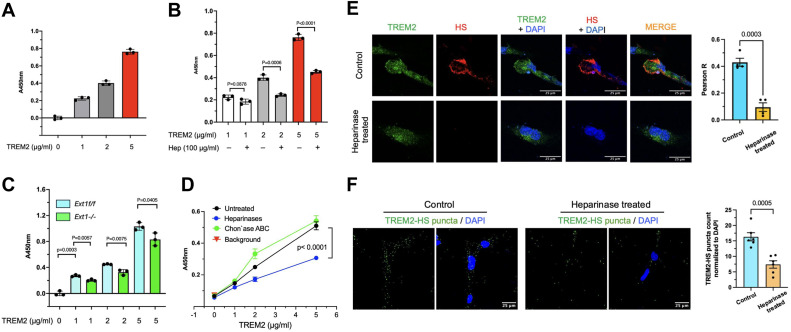
The triggering receptor expressed on myeloid cells-2 (TREM2), a pivotal innate immune receptor, orchestrates functions such as inflammatory responses, phagocytosis, cell survival, and neuroprotection. TREM2 variants R47H and R62H have been associated with Alzheimer's disease, yet the underlying mechanisms remain elusive. Our previous research established that TREM2 binds to heparan sulfate (HS) and variants R47H and R62H exhibit reduced affinity for HS. Building upon this groundwork, our current study delves into the interplay between TREM2 and HS and its impact on microglial function. We confirm TREM2's binding to cell surface HS and demonstrate that TREM2 interacts with HS, forming HS‑TREM2 binary complexes on microglia cell surfaces. Employing various biochemical techniques, including surface plasmon resonance, low molecular weight HS microarray screening, and serial HS mutant cell surface binding assays, we demonstrate TREM2's robust affinity for HS, and the effective binding requires a minimum HS size of approximately 10 saccharide units. Notably, TREM2 selectively binds specific HS structures, with 6‑O‑sulfation and, to a lesser extent, the iduronic acid residue playing crucial roles. N‑sulfation and 2O‑sulfation are dispensable for this interaction. Furthermore, we reveal that 6‑O‑sulfation is essential for HS‑TREM2 ternary complex formation on the microglial cell surface, and HS and its 6‑O‑sulfation are necessary for TREM2‑mediated ApoE3 uptake in microglia. By delineating the interaction between HS and TREM2 on the microglial cell surface and demonstrating its role in facilitating TREM2‑mediated ApoE uptake by microglia, our findings provide valuable insights that can inform targeted interventions for modulating microglial functions in Alzheimer's disease.
Associated Publications
Ilayda Ozsan McMillan; Li Liang; Guowei Su; Xuehong Song; Kelly Drago; Hua Yang; Claudia Alvarez; Amika Sood; James Gibson; Robert J. Woods; Chunyu Wang; Jian Liu; Fuming Zhang; Tom J. Brett; Lianchun Wang
Journal of Biological Chemistry
Data Files & Attachments
1 File(s) Available
| File Name | Description | File Type | Size | Action |
|---|---|---|---|---|
| Supporting Information | Supporting Information | ZIP | 5.97 MB | Login to Download |
Research Keywords & Tags