GLDP000154
In-House Research
Ethyl cellulose-block-poly(benzyl glutamate) block copolymer compatibilizers for ethyl cellulose/poly(ethylene terephthalate) blends
Chronicle Description
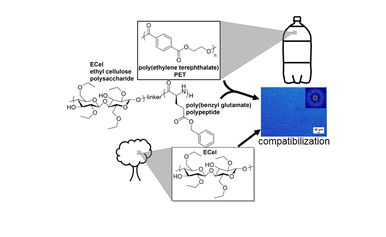
Blends of petroleum-based polymers with bio‑sourced polymers are an alternative to polymers derived from non‑renewable resources. However, polymer blends are usually immiscible, and a compatibilizer, often a block copolymer, is required to improve mixing. In this work, we synthesized a block copolymer of ethyl cellulose (ECel) and poly(benzyl glutamate), termed ECel‑block‑poly(BG), and we applied it as a compatibilizer for ECel/poly(ethylene terephthalate) (ECel/PET) blends. To synthesize this block copolymer, two ECel‑NH₂ macroinitiators were evaluated for ring‑opening polymerization of benzyl glutamate‑N‑thiocarboxyanhydride (BG‑NTA), one with the amine directly attached to the ECel reducing chain end, and the other with a short PEG linker between ECel and the amine initiator. The PEG‑containing macroinitiator led to the synthesis of a block copolymer that was unimodal by size‑exclusion chromatography (SEC) while the other initiator led to uncontrolled homopolymerization of BG‑NTA, presumably due to steric hindrance near the primary amine. A series of solvent studies revealed that polymerization of BG‑NTA in CH₂Cl₂ was the best system for obtaining the ECel‑block‑poly(BG) block copolymer, achieving 95 % conversion based on ¹H NMR spectroscopy. The success of chain extension and molecular‑weight analysis were evaluated using SEC with multi‑angle light scattering (SEC‑MALS). Blends composed of 70 % ECel and 30 % PET with different weight percentages (wt %) of block‑copolymer compatibilizer were made via solvent casting from hexafluoroisopropanol. Phase‑contrast optical microscopy and small‑angle laser light scattering were used to probe the effectiveness of the ECel‑block‑poly(BG) block copolymer as a compatibilizer (5–30 wt %) for the 70/30 ECel/PET blends. A decrease in average domain size from 15 ± 4 µm in the base blend (without compatibilizer) to 2 ± 1 µm in the blend containing 30 wt % ECel‑block‑poly(BG) indicated successful compatibilization of the blend.
Associated Publications
Abigail F. Chinn; Isabela Trindade Coutinho; Saipranavi Reddy Kethireddy; Noah R. Williams; Kenneth M. Knott; Robert B. Moore; John B. Matson
Polymer Chemistry
Data Files & Attachments
No files attached to this chronicle.
Research Keywords & Tags
Related Chronicles