GLDP000157
External User Chronicle
Discovery of a single-subunit oligosaccharyltransferase that enables glycosylation of full-length IgG antibodies in bacteria
Chronicle Description
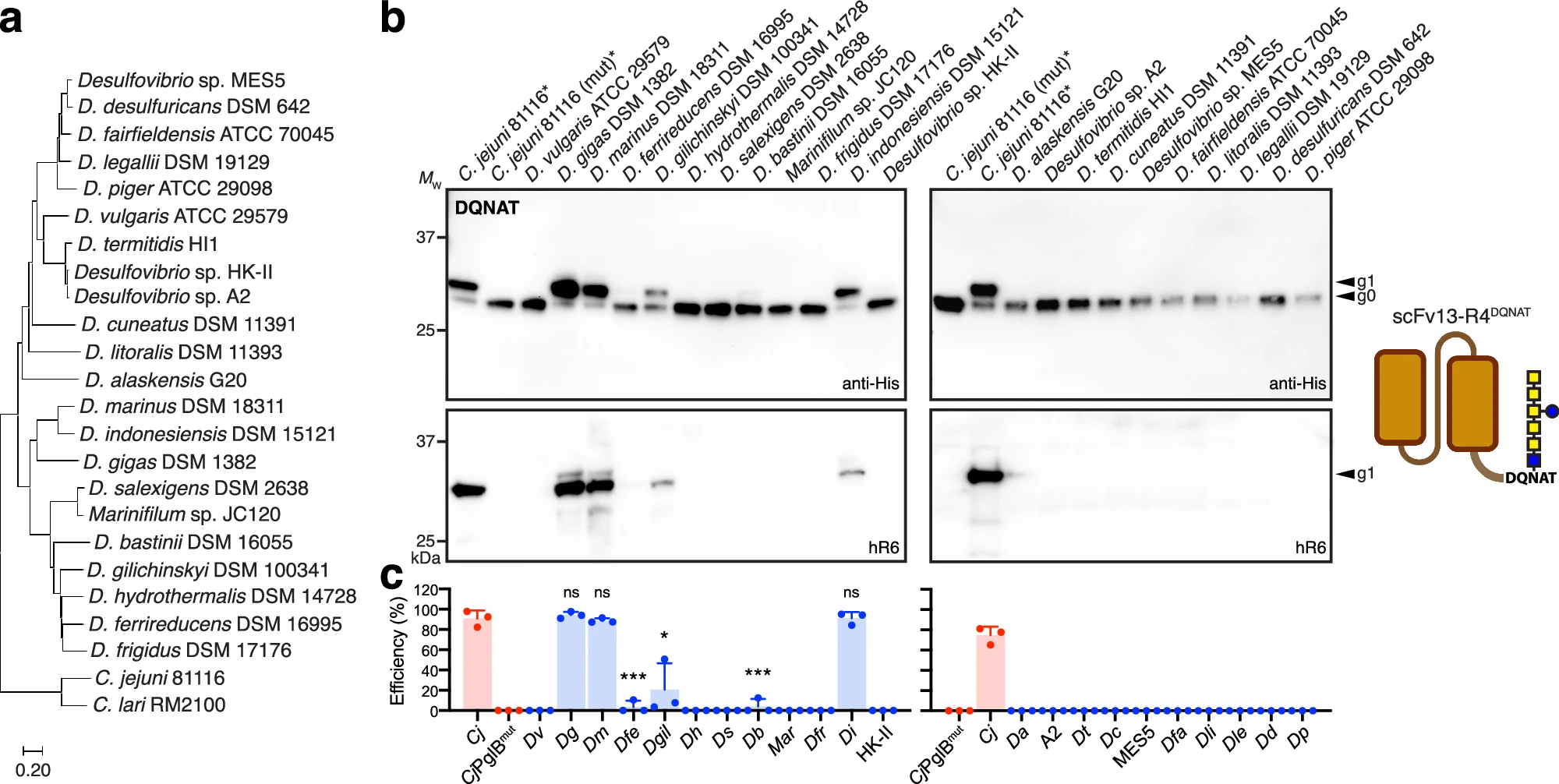
Human immunoglobulin G (IgG) antibodies are a major class of biotherapeutics and undergo N‑linked glycosylation in their Fc domain, which is critical for immune functions and therapeutic activity. Hence, technologies for producing authentically glycosylated IgGs are in high demand. Previous attempts to engineer Escherichia coli for this purpose have met limited success due in part to the lack of oligosaccharyltransferase (OST) enzymes that can install N‑glycans at the conserved N297 site in the Fc region. Here, we identify a single‑subunit OST from Desulfovibrio marinus with relaxed substrate specificity that catalyzes glycosylation of native Fc acceptor sites. By chemoenzymatic remodeling the attached bacterial glycans to homogeneous, asialo complex‑type G2 N‑glycans, the E. coli‑derived Fc binds human FcγRIIIa/CD16a, a key receptor for antibody‑dependent cellular cytotoxicity (ADCC). Overall, the discovery of D. marinus OST provides previously unavailable biocatalytic capabilities and sets the stage for using E. coli to produce fully human antibodies.
Associated Publications
Belen Sotomayor; Thomas C. Donahue; Sai Pooja Mahajan; May N. Taw; Sophia W. Hulbert; Erik J. Bidstrup; D. Natasha Owitipana; Alexandra Pang; Xu Yang; Souvik Ghosal; Christopher A. Alabi; Parastoo Azadi; Jeffrey J. Gray; Michael C. Jewett; Lai-Xi Wang; Matthew P. DeLisa
Nature Communications
Data Files & Attachments
1 File(s) Available
| File Name | Description | File Type | Size | Action |
|---|---|---|---|---|
| Supporting Information | Supporting Information | 50.51 MB | Login to Download |
Research Keywords & Tags
Related Chronicles