GLDP000143
External User Chronicle
Modulation of the pharmacokinetics of soluble ACE2 decoy receptors through glycosylation
Chronicle Description
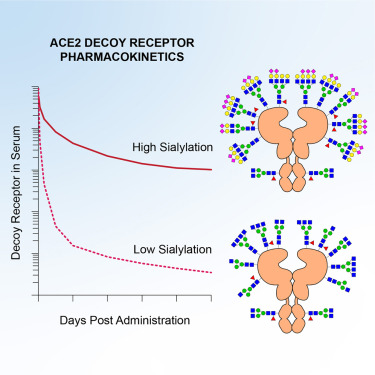
The Spike of SARS‑CoV‑2 recognizes a transmembrane protease, angiotensin‑converting enzyme 2 (ACE2), on host cells to initiate infection. Soluble derivatives of ACE2, in which Spike affinity is enhanced and the protein is fused to the Fc of an immunoglobulin, are potent decoy receptors that reduce disease in animal models of COVID‑19. Mutations were introduced into an ACE2 decoy receptor, including adding custom N‑glycosylation sites and a cavity‑filling substitution together with Fc modifications, which increased the decoy's catalytic activity and provided small to moderate enhancements of pharmacokinetics following intravenous and subcutaneous administration in humanized FcRn mice. Most prominently, sialylation of native glycans increases exposures by orders of magnitude, and the optimized decoy is therapeutically efficacious in a mouse COVID‑19 model. Ultimately, an engineered and highly sialylated decoy receptor produced using methods suitable for manufacture of representative drug substance has high exposure with a 5‑ to 9‑day half‑life. Finally, peptide epitopes at mutated sites in the decoys generally have low binding to common HLA class II alleles and the predicted immunogenicity risk is low. Overall, glycosylation is a critical molecular attribute of ACE2 decoy receptors and modifications that combine tighter blocking of Spike with enhanced pharmacokinetics elevate this class of molecules as viable drug candidates.
Associated Publications
Savanna Skeeters; Kamal Bagale; Galina Stepanyuk; David Thieker; Aaron Aguhob; Kui K. Chan; Benjamin Dutzar; Sergei Shalygin; Asif Shajahan; Xu Yang; Paul A. DaRosa; Emily Frazier; Maximilian M. Sauer; Lisa Bogatzki; Kelly A. Byrnes-Blake; Yifan Song; Parastoo Azadi; Eric Tarcha; Lianghui Zhang; Erik Procko
Molecular Therapy - Methods & Clinical Development
Data Files & Attachments
1 File(s) Available
| File Name | Description | File Type | Size | Action |
|---|---|---|---|---|
| Supporting Information | Supporting Information | ZIP | 10.26 MB | Login to Download |
Research Keywords & Tags
Related Chronicles