GLDP000160
External User Chronicle
Glycosylation of Structured Protein Domains in Cell-Free Reaction Environments
Chronicle Description
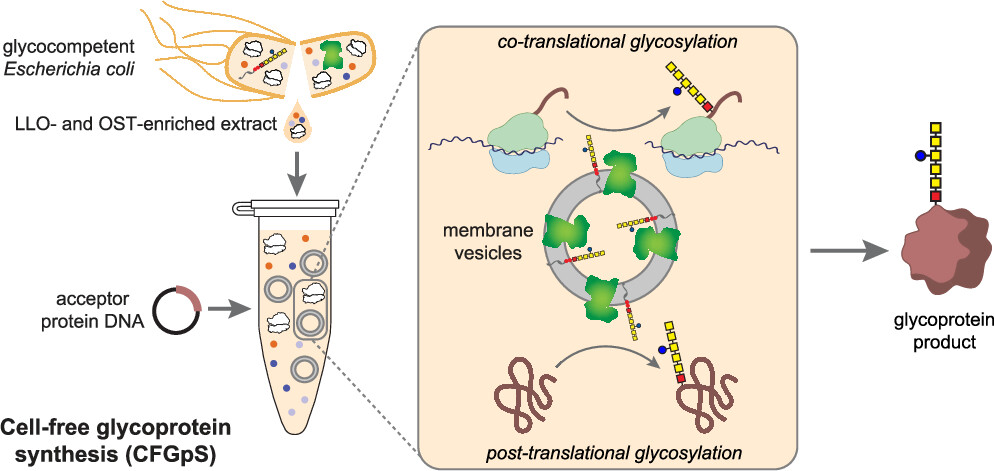
The production of N -linked glycoproteins in genetically tractable bacterial hosts and their cell-free extracts holds great promise for low-cost, customizable, and distributed biomanufacturing of glycoconjugate vaccines and glycoprotein therapeutics. In nearly all bacterial N -linked protein glycosylation systems described so far, a single-subunit, transmembrane oligosaccharyltransferase (OST) is employed which favors acceptor sites in flexible, solvent-exposed motifs of the glycoprotein substrate. Yet despite this preference, acceptor sites in structured domains can also be glycosylated in living bacteria, presumably by a mechanism where the site is presented to the OST in a flexible form during or after the membrane translocation step but prior to
Associated Publications
Erik J. Bidstrup; Kyle Hill; Chandra K. Bandi; D. Natasha Owitipana; Alina Chisti; Rochelle Aw; Xu Yang; Parastoo Azadi; Michael C. Jewett; Lai-Xi Wang; Weston Kightlinger; Matthew P. DeLisa
ACS Synthetic Biology
Data Files & Attachments
1 File(s) Available
| File Name | Description | File Type | Size | Action |
|---|---|---|---|---|
| Supporting Information | Supporting Information | 9.34 MB | Login to Download |
Research Keywords & Tags
Related Chronicles